Lesson 2 of 12 / Nutrition and transport in plants
Finding xylem and phloem
Which transport tissue is which in a stem or leaf section?
I can identify the positions and functions of xylem, sieve-tube elements and companion cells in herbaceous dicots.
I can identify xylem and phloem positions and functions in herbaceous dicot leaf/stem sections.Syllabus
Syllabus K325, Topic 10(b). Identify xylem and phloem positions and functions in herbaceous dicot leaf/stem sections.
About 6 min
Make a guess. You are not marked.
Xylem and phloem are both transport tubes in a plant. Are they both made of living cells?
Show the answer
No. Xylem vessels are dead; phloem sieve tubes are living.
Mature xylem vessels are hollow and dead. Phloem sieve-tube elements are living and need companion cells.
The key idea
Xylem carries water and mineral ions; phloem carries food, mainly sucrose. Their positions help identify them in a dicot section.
Xylem carries water and mineral ions. Its mature vessels are hollow and dead with lignified walls. In a dicot stem bundle it is nearer the centre; in a leaf vein it is towards the upper surface.
Blue: xylem. Gold: phloem. Heavier outline: selected tissue. Original herbaceous dicot schematics, not to scale; a real microscope section may show only part of a structure.
Read a real microscope section
Find the ring of vascular bundles. Within a bundle, which large open vessels face the centre of the stem?
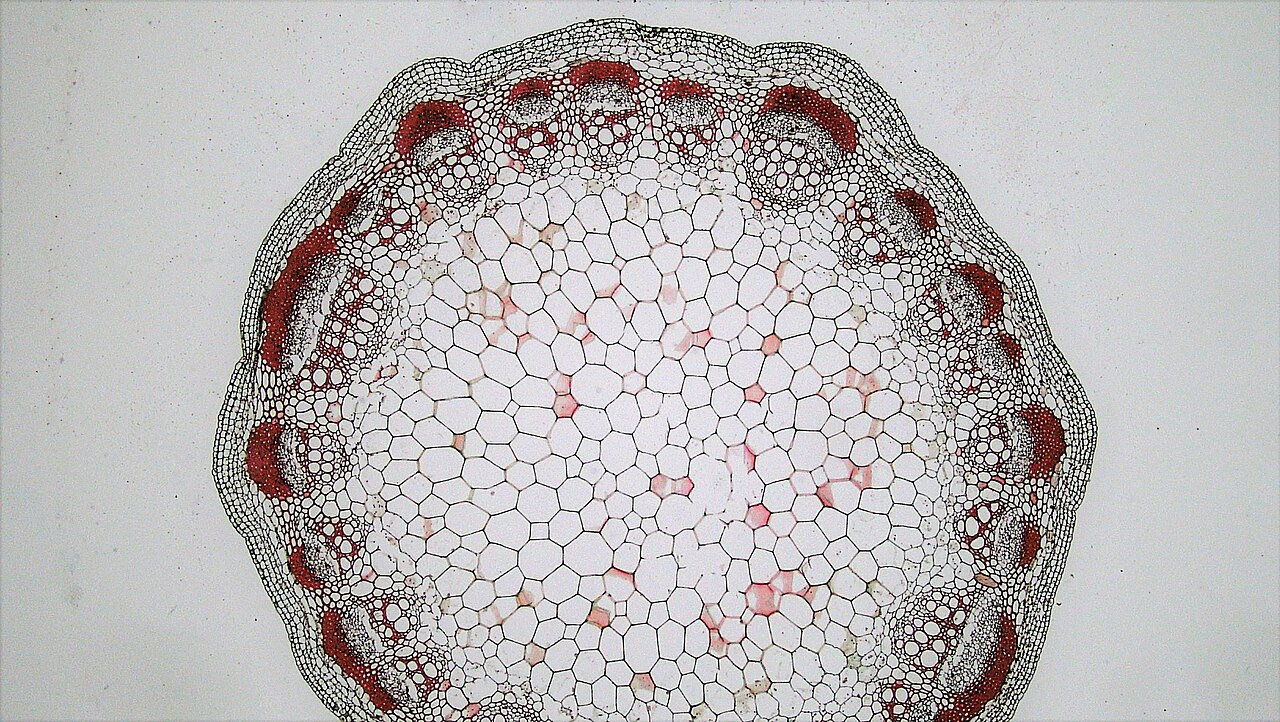
Image size changes with your screen. Use a stated scale bar for measurements; do not calculate from the display size alone. Practise slide preparation and focusing in your laboratory.
Explanation
In a typical herbaceous dicot stem cross-section, vascular bundles form a ring. Within each bundle, xylem is nearer the centre of the stem and phloem is nearer the outside. In a leaf vein, xylem is usually towards the upper surface and phloem towards the lower surface.
Mature xylem vessels are formed from dead cells with hollow interiors and no end-wall barriers to continuous flow. Their lignified walls strengthen them and help prevent collapse under tension. Xylem transports water and dissolved mineral ions from roots towards the leaves and also supports the plant.
Phloem includes sieve-tube elements joined end to end, with perforated sieve plates allowing sap to pass between them. The conducting sieve-tube elements are living but have reduced contents and lack a nucleus at maturity. Adjacent companion cells have nuclei and support their metabolism and loading or unloading of sugars.
Use both position and visible features in an identification question. Xylem often has relatively large open vessels with thick walls; phloem contains smaller living cells. A schematic isolates these patterns, while a real light-microscope image may not show every cell boundary or sieve plate clearly in one section.
Step by step
- 1
Identify the organ
Stem and leaf sections have different reference directions.
- 2
Use position
Compare centre/outside in the stem or upper/lower in the leaf.
- 3
Confirm with structure and cargo
Match thick hollow xylem vessels with water/mineral ions and living phloem with food transport.
Worked example
A stem bundle
In a herbaceous dicot stem, tissue A lies on the inner side of a vascular bundle and has large thick-walled vessels. Identify it and its transported substances.
One way to explain it
A is xylem. It transports water and dissolved mineral ions from roots towards the leaves, and its lignified walls also provide support.
Why this answer works
- Inner position is relative to the stem centre.
- Large thick-walled vessels support the identification.
- State water and mineral ions, not sucrose.
Watch out for this
A student says: "Every transport tube is a dead, empty pipe." What is wrong with this?
Show the answer
Mature xylem vessels are dead and hollow. Phloem sieve-tube elements are living and depend on companion cells.
Check your understanding
Which statement describes a typical herbaceous dicot stem bundle?
Show the answer
Xylem is on the inner side, while phloem is on the outer side.
Use these positions within each bundle, which forms part of a ring in a typical dicot stem.
Quick recall
Which transport tissue is which in a stem or leaf section?