Lesson 1 of 12 / Nutrition and transport in flowering plants
Leaf structure and gas exchange
How does a leaf bring carbon dioxide close to its chloroplasts?
I can identify tissues in a dicot leaf section and explain their roles in photosynthesis and gas exchange.
I can identify dicot leaf tissues and explain their functions.Syllabus
Syllabus K224 / K225, Topic 8(a). Identify dicot leaf tissues and explain their functions.
I can describe carbon dioxide movement to mesophyll cells.Syllabus
Syllabus K224 / K225, Topic 8(g). Describe carbon dioxide movement to mesophyll cells.
About 6 min
Make a guess. You are not marked.
A leaf needs carbon dioxide for photosynthesis. How does most of it reach the cells inside the leaf?
Show the answer
Through stomata, then through air spaces inside the leaf.
Carbon dioxide diffuses in through open stomata and spreads through air spaces to the mesophyll cells.
The key idea
Stomata and mesophyll air spaces shorten the diffusion route to photosynthesising cells; chloroplast-rich palisade tissue captures light.
Palisade mesophyll: Closely packed elongated cells with many chloroplasts, near the illuminated upper surface.
Brown ring: selected feature. Dark green ovals: chloroplasts. Blue/gold in the vein: xylem/phloem. Original schematic of a typical dicot section, not a microscope photograph; sizes and cell numbers are simplified.
Read a real microscope section
Find the upper epidermis, palisade tissue and spongy tissue. Which visible pattern suggests a route for gases within the leaf?
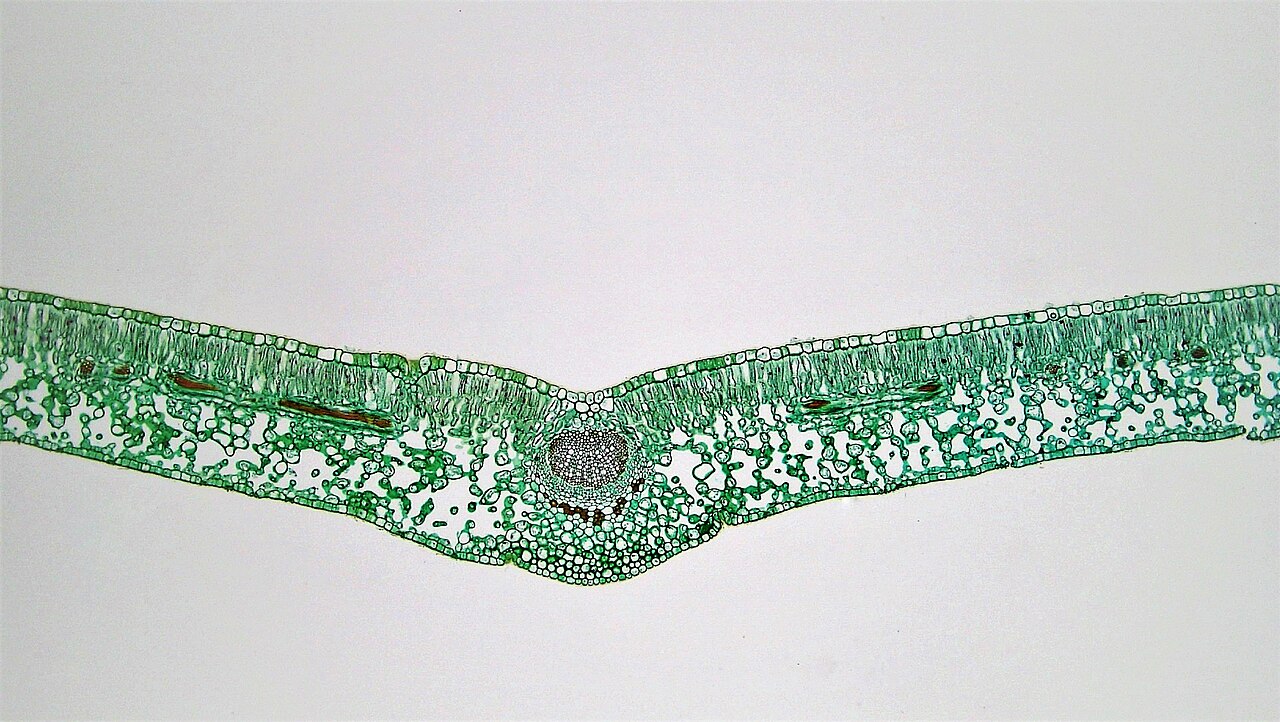
Image size changes with your screen. Use a stated scale bar for measurements; do not calculate from display size alone. Practise specimen observation and focusing in your laboratory.
Explanation
A leaf has layers: the upper epidermis, the palisade mesophyll, the spongy mesophyll and the lower epidermis. The epidermis is clear, so light gets through to the mesophyll. A waxy cuticle on top cuts down water loss. Palisade cells sit near the top, where the light is, and are packed with chloroplasts.
The spongy mesophyll has loosely packed cells with large air spaces between them. Gases spread through these spaces, and the moist cell surfaces give a large area for gas exchange. Spongy cells have some chloroplasts, but fewer than palisade cells.
Stomata are tiny pores, mostly on the lower surface. Each stoma is opened and closed by two guard cells. When the leaf is photosynthesising, carbon dioxide diffuses in through the open stomata, spreads through the air spaces, dissolves in the moist cell walls and diffuses into the cells to the chloroplasts.
A vascular bundle (vein) contains xylem, which brings water and mineral ions, and phloem, which carries food away. Link each part to its job: chloroplasts to photosynthesis, stomata and air spaces to gas exchange, and veins to transport.
Step by step
- 1
Orient the section
Find the upper epidermis and the palisade layer below it.
- 2
Trace the gas route
Follow carbon dioxide from a stoma through air spaces into mesophyll cells.
- 3
Link structure to function
Explain how the arrangement supports light absorption, diffusion or transport.
Worked example
An irregular tissue with air spaces
A light-microscope section shows irregular cells separated by large spaces below the palisade layer. Identify the tissue and explain a function.
One way to explain it
It is spongy mesophyll. Its interconnected air spaces allow gases such as carbon dioxide to diffuse through the leaf towards mesophyll cells, where carbon dioxide is used in photosynthesis.
Why this answer works
- Use position and arrangement together.
- Name the tissue rather than just "air holes".
- Link the spaces to diffusion and photosynthesis.
Watch out for this
A student says: "Carbon dioxide enters the xylem and is carried to each chloroplast." What is wrong with this?
Show the answer
Carbon dioxide reaches mesophyll cells mainly by diffusion through stomata and air spaces. Xylem transports water and mineral ions.
Check your understanding
Which route correctly describes carbon dioxide entering a photosynthesising leaf?
Show the answer
Stoma -> air space -> moist mesophyll cell wall -> cell -> chloroplast
Carbon dioxide diffuses down its concentration gradient and dissolves at the moist cell surface before entering cells.
Quick recall
How does a leaf bring carbon dioxide close to its chloroplasts?