Lesson 4 of 5 / Cell structure and organisation
Mitochondria and ribosomes
Which organelle releases energy, and which makes protein?
I can identify mitochondria and ribosomes in diagrams and electron micrographs and state their functions.
I can identify mitochondria and ribosomes and state their functions.Syllabus
Syllabus K224 / K225, Topic 1(b). Identify mitochondria and ribosomes and state their functions.
About 5 min
Make a guess. You are not marked.
A muscle cell contracts again and again all day. Which organelle would you expect it to have lots of?
Show the answer
Mitochondria, to release energy by aerobic respiration.
Repeated contraction needs a steady energy supply. Aerobic respiration in mitochondria releases it.
The key idea
Mitochondria are sites of aerobic respiration; ribosomes synthesise proteins. A cell needs both processes to function.
Electron micrographs show finer detail than light micrographs. These images are sections through cells, so the same structure can look different at different angles.
Explore the idea
Energy release or protein synthesis?
Use the micrograph below. Find the enclosing boundary and the internal folds.
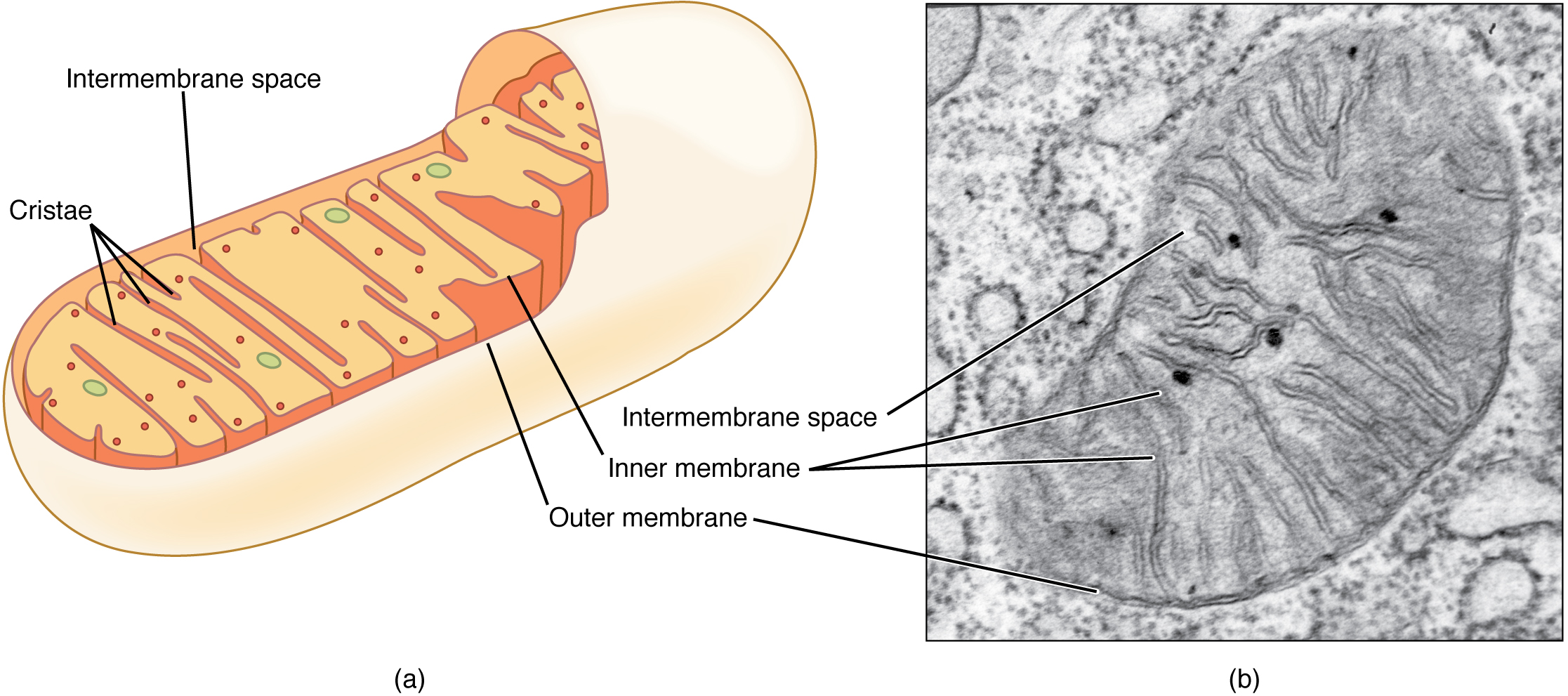
The original diagrams and micrographs have different illustrative scales. A diagram is a model, while a micrograph records a specimen.
Explanation
Mitochondria are where aerobic respiration happens. Aerobic respiration releases energy from food for the cell to use. Cells that need a lot of energy, such as muscle cells, usually have many mitochondria.
In an electron micrograph, a mitochondrion has an outer boundary and a folded inner membrane. The folds are the best clue. An oval shape alone is not enough, because other parts of the cell can also look oval.
Ribosomes are much smaller. They make proteins by joining amino acids together. In an electron micrograph they look like tiny dark dots, either free in the cytoplasm or on membranes. You cannot see single ribosomes with a school light microscope.
A cell that makes protein needs both: ribosomes to build the protein, and mitochondria to release the energy it uses. Do not mix up their jobs. Mitochondria do not make proteins, and ribosomes do not carry out respiration.
Step by step
- 1
Inspect the image
Look for internal folds or a repeated pattern of small dense dots.
- 2
Name the structure
Distinguish the mitochondrion from the much smaller ribosomes.
- 3
State its job
Connect respiration to energy release and ribosomes to protein synthesis.
Worked example
An active muscle cell
A muscle cell has many organelles with folded inner membranes. Identify them and explain why they are useful.
One way to explain it
They are mitochondria. They provide a large capacity for aerobic respiration, releasing energy for repeated muscle contraction.
Why this answer works
- Use the internal folds as identification evidence.
- Connect the named organelle to respiration.
- Link energy release to the specific activity: contraction.
Watch out for this
A student says: "Ribosomes release energy while mitochondria make proteins." What is wrong with this?
Show the answer
Ribosomes synthesise proteins. Mitochondria are sites of aerobic respiration, releasing energy for cell activities.
Check your understanding
Which statement correctly interprets an electron micrograph?
Show the answer
An organelle with a folded inner membrane is consistent with a mitochondrion, a site of aerobic respiration.
The internal pattern supports the identification and is linked to the correct function.
Exam-style questions
Check your understanding
A gland cell makes and secretes large amounts of an enzyme. Which pair of structures would you expect to find in large numbers?
Show the answer
Ribosomes and mitochondria
Ribosomes make the protein, and mitochondria release energy for making and secreting it.
Quick recall
Which organelle releases energy, and which makes protein?